The FIFA World Cup 2026™ is shaping up to be a stage for legendary encounters, and a potential semi-final between France and Spain promises to be one of the most exciting. This clash would not only pit two historical European football powerhouses against each other but also two models of squad evolution and individual stars at their peak, whose journey throughout the tournament would be decisive in reaching the coveted final.
The Evolution of Squads: Youth and Experience

Photo: Caio Cezar / Pexels (https://www.pexels.com/photo/aerial-view-of-santiago-bernabeu-stadium-in-madrid-33845031/)
Both teams arrive at the World Cup with squads that combine the maturity of their pillars with the impetus of a new generation of talents. Spain, in particular, has seen a "golden generation" of youngsters emerge. Names like Lamine Yamal, considered by many to be the greatest symbol of the Spanish national team's future, Pau Cubarsí, Gavi, and Nico Williams have established themselves as realities in world football, bringing flair, vision, and remarkable tactical maturity despite their youth. These talents integrate with the experience of key players like Rodri in midfield, who dictates the tempo and organises build-up play, and Unai Simón in goal, a goalkeeper with international tournament experience.
La Roja has demonstrated the effectiveness of this mix, winning the 2024 European Championship and the 2025 UEFA Nations League, successes that reflect a combination of individual quality and solid collective tactical organisation.
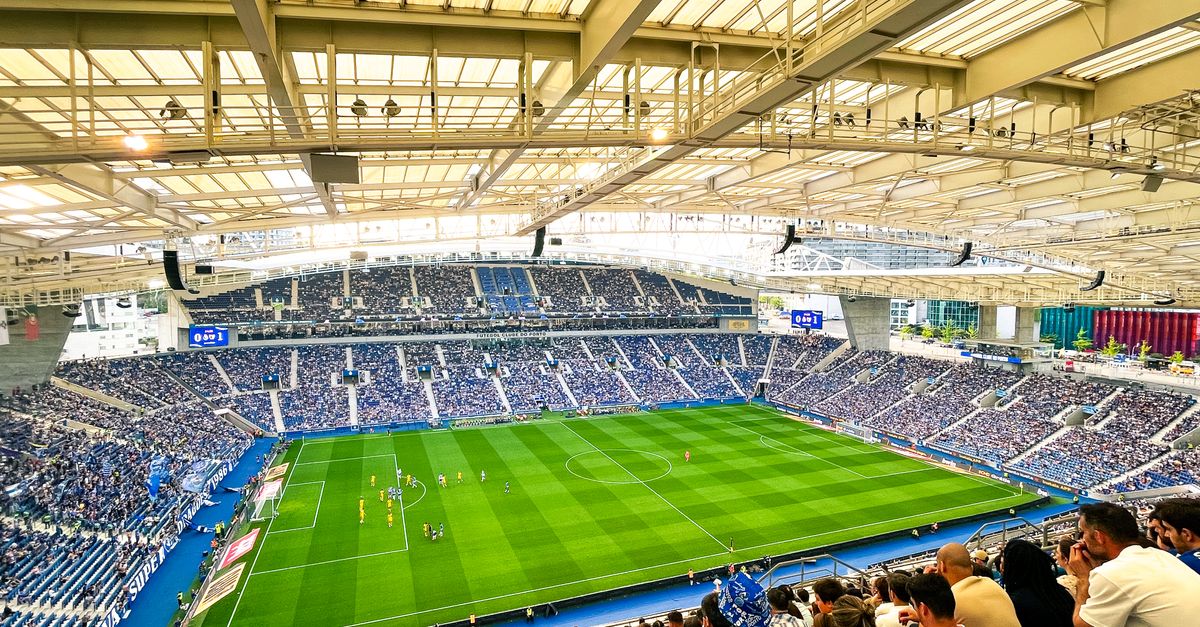
Photo: Caio Cezar / Pexels (https://www.pexels.com/photo/vibrant-football-match-at-porto-s-estadio-do-dragao-34304358/)
France, on the other hand, maintains a core of established stars and has incorporated promising young players who ensure the continuity of their dominance. Kylian Mbappé remains the main offensive reference, aiming to break records in North America. Alongside him, figures like Ousmane Dembélé and Aurélien Tchouaméni bring experience and quality. The emergence of talents like Désiré Doué, Warren Zaïre-Emery, and Michael Olise, who combine physical power, refined technique, and tactical versatility, guarantees a deep and versatile squad. Les Bleus, runners-up in the 2022 World Cup and champions in 2018, have consistently shown that their generation is one of the most potent in world football.
Contrasting Styles of Play
The tactical clash would be fascinating. Spain, under Luis de la Fuente, has maintained its distinctive possession-based game, the famous "tiki-taka," characterised by short passes, constant movement, and build-up from the back. However, this style has evolved towards greater versatility and dynamism, seeking high pressing and quick ball recovery to create chances. Wingers are crucial for stretching the opposition defence and creating space for creative midfielders.
France, on the other hand, is distinguished by an offensive and dynamic approach, where individual technique and speed are fundamental. Their style has evolved to prioritise ball possession and attacking play, establishing themselves as an international benchmark. They use flexible formations like 4-3-3 or 4-2-3-1 to maximise their effectiveness, emphasising offensive power and defensive solidity, being highly versatile in all phases of play. The ability of their players for quick counter-attacks and individual skill to beat defenders in one-on-one situations are distinctive hallmarks.
Key Figures: Individual Impact in the Tournament
The journey of both teams to a hypothetical semi-final would largely depend on the sustained performance of their stars. For Spain, Lamine Yamal could be the most decisive player, with his aggressive style and constant search for goals. Pedri and Rodri would be the engine of the midfield, controlling the tempo and distribution, while defenders like Pau Cubarsí would provide solidity and clean build-up play.
For France, Kylian Mbappé would undoubtedly be the difference-maker, with his ability to decide matches and lead the attack. In midfield, Aurélien Tchouaméni would stand out for his recovery ability and leadership, and the defensive solidity of players like William Saliba or Jules Koundé would be vital.
The Tactical Battle and Head-to-Head
The tactical battle between Luis de la Fuente and Didier Deschamps (or his eventual successor) would be a true battle of wits. Recent encounters between the two teams have been intense and favourable to Spain in decisive stages, with victories in the semi-finals of Euro 2024 (2-1) and the 2025 UEFA Nations League (5-4). However, the overall record in knockout matches in major tournaments has slightly favoured France in the past, including a win in the Round of 16 of the 2006 World Cup. This rivalry, spanning over a century, adds a special flavour to any encounter.
Ultimately, a semi-final between France and Spain at the 2026 World Cup would be a clash of titans where the tactical evolution of each squad throughout the tournament and the ability of their stars to shine in key moments would be the pillars upon which the path to the grand final would be built.